News from Zimbabwe

Have a heart for those fellow Africans
now desperately fleeing our country
Most people from other African countries are not in South Africa because they want to be, but because their countries have been ruined by corrupt elites. For South Africans to turn their anger on desperate migrants in brutal xenophobic attacks, instead of those elites, is the most inhumane and cowardly thing to do, writes Mark Heywood, a social justice activist and former Editor of Maverick Citizen in South Africa. “If you had seen Donald, witnessed his tears, considered the fear that had entered his life, I think – I hope – that you would understand and stop what you are doing. You still can.”

Constitutional Amendment Bill No. 3: What ordinary Zimbabweans are asking
Zimbabweans do not want Constitutional Amendment Bill No. 3, which President Mnangagwa and his ZANU PF party are trying to force through Parliament. “What I hear are cries for jobs. Calls for affordable education. Pleas for food on the table. Demands for reliable transport, decent accommodation, functional hospitals with medication, and an end to the drug abuse that is destroying our young people… (This is) not a constitutional crisis. It is a governance crisis…”, the CCC party’s Lynette Karenyi-Kore who is MP for Chikanga Constituency in Mutare, has told the National Assembly.

The US$20 million wedding, the leaked audio and the making of a captured presidency
A society in which money buys political influence is dangerous enough. A society in which political influence creates wealth is worse still,” writes Trevor Ncube, chairman of Alpha Media Holdings. “The reported US$20 million wedding of businessman Kudakwashe Tagwirei’s son was a vivid display of that reality. It was not merely a family celebration. It was a public exhibition of wealth and influence. The message was unmistakable: we no longer belong with the people.

Calls grow for assistance to help returning children enrol in school
Increasing numbers of Zimbabwean families who have fled the xenophobic violence in South Africa are arriving at the temporary reception and transit centre at the United Congregational Church of Southern Africa (UCCSA) in Njube, Bulawayo, where government departments, churches and volunteers are coordinating assistance for the returnees. Desmond Ntini, who coordinates operations at the repatriation centre alongside church leaders, said the centre has become more than a place of temporary shelter, but often the first point of contact for families trying to rebuild their lives.

Relief fades for migrant Zimbabweans fleeing
South Africa
Stitches zigzag across the left side of Shingirai Kurebwaseka’s head, after he was badly beaten in a wave of xenophobic protests against foreign migrants that have swept South Africa. “They beat me all over, smashed my foot with a hammer, burned me with some plastic papers which they had lit and were going to put a tyre around me but I somehow still managed to escape,” he told AFP. More than 100,000 Zimbabweans have fled South Africa in recent weeks and many arrive with little more than the clothes they were wearing, after spending years in South Africa and faithfully sending money home.

Anti-migrant violence triggers trauma and medical emergency on the South Africa-Zimbabwe border
“…. Across the border in Beitbridge, Médecins Sans Frontières (MSF)’s counsellors are concerned about the trauma their patients are experiencing after fleeing the xenophobic violence in South Africa. Nobuhle, who has been living in Johannesburg and working as a chef at a local restaurant, was devastated to return from work to find her house had been burnt down. Luckily, her three children were away at the time. “I lost my house, my passport and permit, all my clothes and furniture, my children's birth records and birth certificates. I have nothing with me. All I have is this small handbag….”

Catholic bishops urge parliament to reject Constitutional Amendment (No.3) Bill in its entirety
Zimbabwe’s Catholic bishops have submitted a sweeping rejection of the ZANU PF government’s Constitution Amendment (No. 3) Bill, 2026, warning that the bill erodes democratic safeguards, weakens institutional independence and erodes constitutional safeguards against the concentration and abuse of power. The bishops reserved their greatest concern for Clause 2, which proposes to scrap the direct election of the president by registered voters and replace it with a parliamentary vote, with the Senate and National Assembly sitting jointly.
Treasury’s 2 000 teacher plan
sparks outrage
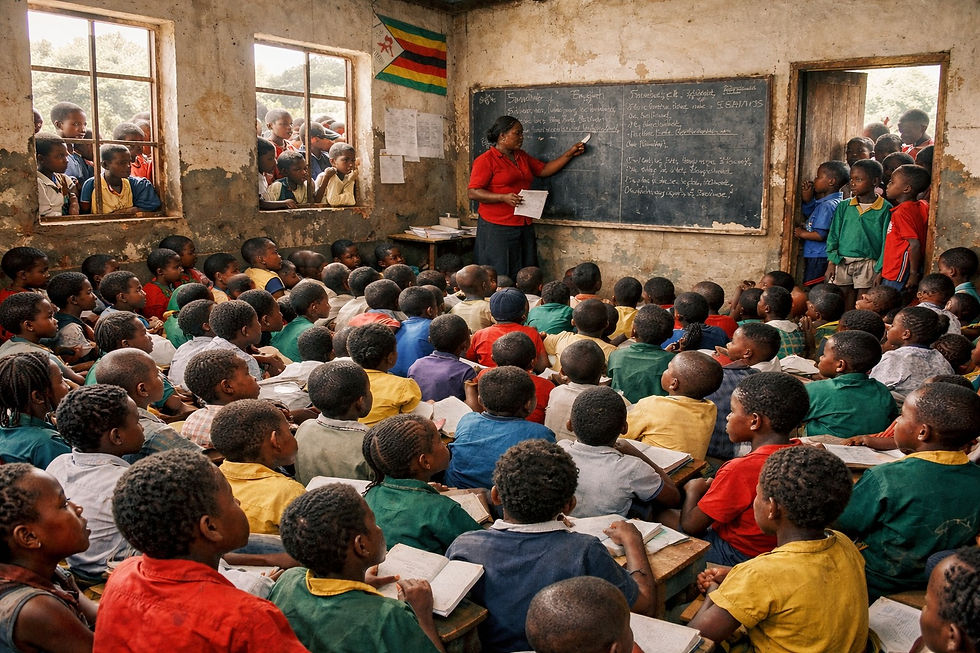
The Zimbabwe Government’s decision to recruit only 2 000 teachers this year has triggered concern among education stakeholders. During a recent Parliamentary Q&A session, the Public Service minister admitted that while government wishes to fully staff schools, financial constraints continue to stand in the way. The Amalgamated Rural Teachers Union of Zimbabwe (ARTUZ) spokesperson said Zimbabwe required nearly 90 000 teachers to adequately address the current staffing deficit. However, teachers’ unions say the figure is insignificant compared to the scale of the crisis.

Cathy Buckle: 409 farmers in Zimbabwe;
it's all as clear as mud
‘We are not giving land back to white farmers,’ said agriculture minister Anxious Masuka, this week. He then announced that 67 farms that were protected by BIPPAs (Bilateral Investment Promotion and Protection Agreements) including from Denmark, Germany, the Netherlands and Switzerland, would have their farms returned to them. In addition, 409 of the original 4,500 white farmers who have been ‘peacefully co-existing with local land reform beneficiaries’ would be allowed to purchase the farms they are now occupying (which they own), with a ‘set-off mechanism’.

Global legal outcry over attacks on Zimbabwean lawyers during Constitutional Amendment Bill No. 3 hearings
International legal bodies have raised alarm over what they describe as a growing pattern of physical and verbal attacks on Zimbabwean lawyers, warning the trend threatens the country’s justice system and deters practitioners from taking on sensitive cases. They said the recent attack on prominent human rights lawyer Douglas Coltart at a public hearing on Constitutional Amendment Bill No. 3 in Harare, reflects a broader campaign of harassment against legal professionals and risks silencing dissent within the legal community.

‘Only the weak fear competition’:
Protecting democracy in Africa
According to Freedom House, which has tracked the health of democracy since 1972, by 2026 Africa had experienced 13 consecutive years of decline in democracy, with a rise in military coups, non-competitive elections, restrictions on civic space and weakened democratic institutions. In Zimbabwe, civil society is resisting President Emerson Mnangagwa’s attempts to change the constitution outside of a referendum through Constitutional Amendment Bill No. 3. If this is allowed, it would not only extend his term of office, but also remove his direct election by citizens and thus his accountability.

Looking for hope – Cathy Buckle writes from Zimbabwe
We are having one of those ‘real’ rainy seasons this year and in this horrific time of war in the Middle East, I find myself overwhelmed with sadness and needing to look for hope. Walk with me today…. Beyond the pools and puddles the Cosmos flowers are in full bloom, pink, mauve, purple and white, swaying in the breeze and helping you to exhale, to smile for a moment, to forget for a moment and to see hope. In the plains and valleys, the wild grasses are tall and golden, heavy with seeds, waiting to disperse their bounty into the wind and let the cycle of life start again….

Ben Freeth explains the background to
Zimbabwe’s land invasions
In this 8-minute interview with South African broadcaster Channel Africa, Peter Ndoro, co-host of the ‘Rise & Shine’ current affairs programme, asks Zimbabwean Ben Freeth to explain what happened during the country’s land reform process from 2000 onwards. He also questions why the issue of compensation for the mainly white commercial farmers whose properties were seized (often violently) remains unresolved 25 years later. Ben explains that the newly formed opposition MDC party posed a serious threat to President Mugabe and that taking the land was a strategy to retain power.

Remembering abducted journalist and pro-democracy activist Itai Dzamara
Today marks another year since the disappearance of Zimbabwean journalist and pro-democracy activist Itai Dzamara who was a courageous advocate for peaceful democratic change.Dzamara became widely known for leading the “Occupy Africa Unity Square” movement — a campaign calling for accountability, economic reform, and democratic renewal in Zimbabwe. On the morning of 9 March 2015, Dzamara was abducted from a barber shop in Harare by five unidentified men who forced him into a white truck with concealed number plates. He has never been seen again.

UK Supreme Court dismisses state immunity arguments to contest arbitration awards
Foreign governments cannot rely on state immunity to contest arbitration awards against them when they had submitted to the jurisdiction of the English courts, the UK Supreme Court has ruled. In July 2015, a tribunal of the International Centre for Settlement of Investment Disputes (ICSID) ordered Zimbabwe to restore three agricultural estates seized from the von Pezold family during the land confiscation programme, or pay compensation of around US$196 million as well as interest, costs and US$1m in moral damages. The second award (Border Timbers) ordered payment of US$125 million in damages.

Cathy Buckle: 90 days to stop the coup on Zimbabwe’s Constitution
The ZANU PF government’s Constitution of Zimbabwe Amendment Bill (No 3) proposes that the President will no longer be elected by the people of Zimbabwe but instead be chosen by the members of parliament. It proposes that the Presidential term of office will be extended from 5 to 7 years and that extension will apply to both the current President and to all the Members of Parliament. [However], Zimbabwe finally woke up this week. Voices were raised, meetings were held and Press Conferences convened. Zimbabwe has just 90 days to stop this coup on our Constitution. Dark days lie ahead.

Silenced for Reporting: Zimbabwe’s war on the press with Blessed Mhlanga
In his address at the 18th Geneva Summit for Human Rights & Democracy on 18 February 2026, Zimbabwean journalist Blessed Mhlanga said he was held in pre-trial detention for 73 days, charged with incitement to public violence after covering press conferences by outspoken war veteran Blessed Geza who had called for President Mnangagwa’s resignation. Mhlanga described the new face of repression in Zimbabwe as “lawfare” and cautioned that the worst is yet to come. “Zimbabwe has not become any more democratic, it has just become more sophisticated in its oppression.”
![Demonstration by ZLHR on Int HR day 10 Dec 25 [1].jpg](https://static.wixstatic.com/media/dbd636_b1aa8574421d4975ab21e38c0ead5efb~mv2.jpg/v1/fill/w_980,h_515,al_c,q_85,usm_0.66_1.00_0.01,enc_avif,quality_auto/Demonstration%20by%20ZLHR%20on%20Int%20HR%20day%2010%20Dec%2025%20%5B1%5D.jpg)
Human Rights Watch World Report for 2026 - Zimbabwe Chapter: Events of 2025
The latest Human Rights Watch World Report for 2025 stated that the Zimbabwean government had continued its crackdown on dissent. It noted that the authorities had intimidated, harassed, threatened, and arbitrarily arrested journalists, political opposition members, and civil society activists. It had also intensified restrictions on civic space and freedom of expression, association, and peaceful assembly, including through legislation, notably the Private Voluntary Organizations Amendment Act. It expressed concern that the SAPES Trust offices had been destroyed in a suspected arson attack.

Experts seek local solution as Zims gobbles US$2 billion on food imports amid uncertain international market
Zimbabwe's ballooning food import bill now stands at US$2 billion annually. The Agricultural Marketing Authority (AMA) and Africa Economic Development Strategies (AEDS) have therefore convened a high‑level meeting to explore strategies for reducing the reliance on food imports. "The meeting is convened against a backdrop of heightened global geopolitical uncertainty and repeated supply chain disruptions, which have exposed the risks of reliance on food imports," their statement reads. The statement also warned that food import dependence is a national security vulnerability.

Helping hands change everything
It was a Christmas when the Diaspora came home for the holidays, pushing trolleys full of groceries, filling up the tills. It was a time when we luxuriated in clean bank notes that hadn’t been tucked away in shoes, socks and bras, glued together or washed and dried in the sun. Christmas was a time when National Railways staff didn’t get their December salaries at all and were notified that they would be delayed due to ‘financial challenges”. I sat outside watching the dawn early one morning thinking about our Zimbabwe and how much longer we must live like this, struggling to survive…..

Billionaire Strive Masiyiwa bets on Africa’s future with 100MW solar-powered industrial park in Zimbabwe
Zimbabwean billionaire Strive Masiyiwa’s Econet InfraCo is initiating a substantial 300-hectare industrial development project adjacent to the Robert Mugabe International Airport in Harare. The proposed location aims to blend power, connectivity and logistics to attract manufacturing and export-focused businesses. This is part of a broader strategy that emphasizes artificial intelligence and infrastructural innovation. (Masiyiwa is a highly respected philanthropist widely recognized for his extensive humanitarian work and contributions to health, education and development across Africa.)

SADC Tribunal Still Closed — and Justice Still Denied — 17 Years After Campbell Ruling
Today, 28 November, is the 17th anniversary of the landmark judgment in the Campbell farm test case, Mike Campbell and Others v. the government of Zimbabwe, handed down by the Southern African Development Community (SADC) Tribunal, the region’s court of justice and court of last resort for SADC citizens, in 2007. What does that judgment mean? The first aspect to understand is that the judgment is final and binding from the highest judicial authority in southern Africa. Courts can be emasculated or closed down, but when a final and binding judgment is given, it stands. It cannot be changed.

Newsletter from Cathy Buckle in Zimbabwe
In Cathy Buckle’s 21 November newsletter, she writes about the bizarre goings on in the government: ”… Finally came this unbelievable announcement from the Finance Minister. Speaking to MPs in Parliament he said: “I’m going to announce today that we have bought you a hotel. It’s the Monomatapa Hotel.” The 182-bed four-star Monomatapa Hotel in central Harare has been bought by the government, paid for by the Pension Fund, a Fund meant to support retired teachers, nurses and civil servants. The purchase of the hotel was not debated in, or approved by, parliament….”

Statement about the deteriorating civic space
“The Platform for Concerned Citizens (PCC) in Zimbabwe has been watching the increasing attacks on civil society organisations, students, and citizens in recent months…. The recent bombing of the SAPES Trust Seminar Room is probably the most egregious of these attacks, an attack that has all the hallmarks of domestic terrorism. It is remarkable that there has been no public comment about this by either the government or the security agencies tasked with protecting the state and its citizens. It is of concern that there has been no public statement from either the regional or international community….”

Ben Freeth’s 350km Challenge across Namibia for Poor Families and a School in Zimbabwe
From mid-September, our executive director, Ben Freeth, rode a few spot Appaloosa horse called Warrior across western Namibia to raise funds for three projects in Zimbabwe: a small Christian primary school for underprivileged children that we support, our conservation agriculture training programme and our free, open-pollinated (OPV) seed pack project for poor rural families. He also called for the regional court of justice, the SADC Tribunal, to be reinstated so that the 400m million SADC citizens can once again have access to justice.

Harare vendor wins US$21k lawsuit
against council police
A Harare vendor, James Chamisa, has successfully sued Harare Municipal Police for US$21 000 after he sustained serious injuries following a severe assault in 2018. According to court papers, he was wrongly and unlawfully assaulted by municipal police with batons, fists, booted feet and palms. As a result, he suffered physical bodily injury, including a fractured right hand and two fractured ribs. He also suffered psychological injury and trauma. He was awarded US$1 830 for medical expenses, US$20 000 for shock, pain and suffering and US$10 000 for contumelia (harm and humiliation).

Madhuku trashes Zanu PF
plans to illegally extend Mnangagwa’s second term to 2030
Constitutional law expert Professor Lovemore Madhuku has trashed the ruling party ZANU PF’s attempts to illegally extend President Emmerson Mnangagwa’s second term to 2030. “There is no legal mechanism of doing it as it currently stands,” he said. “The kind of amendments ZAU PF is talking about are not possible without a referendum. There are a few things you can amend without going for a referendum but if you want to tamper with the term of office of the president, the exercise of executive powers or the structure of the state, you cannot avoid a referendum.”